If you manage a commercial fleet, you already know DVSA doesn't need much of an excuse to take a closer look at your drivers' hours records. What might surprise you is quite how many operators are getting caught out, and how avoidable most of it is.
In the first quarter of 2025-26 alone (April to June), DVSA referred 56 tachograph and record-keeping offences and 39 drivers’ hours offences for prosecution, with average fines of £756 and £552 respectively. That's a steady, ongoing stream of infringements across the industry, most of which come down to the same handful of mistakes repeated fleet after fleet.
The good news is that once you know what those mistakes typically look like, they're straightforward to catch and even easier to prevent.
The infringements DVSA sees most often
Missing or incomplete records.
The most basic infringement of all: a driver card inserted late, removed early, or not inserted at all. It sounds minor. It isn't, DVSA treats a gap in the record as a gap in accountability, and it's usually the first thing an inspector checks.
Exceeding driving limits.
Daily limits (9 hours, extendable to 10 twice a week) and weekly limits (56 hours) get breached more often than operators expect, particularly on tight delivery schedules where a driver quietly pushes on to finish a route.
Insufficient rest periods. Daily rest (11 hours, reducible to 9 three times a week) and weekly rest (45 hours) are frequently shortened under scheduling pressure. This is one of the infringements most closely tied to fatigue-related incidents, so it's not just a paperwork issue.
"Other work" not recorded.
Loading, unloading, admin, or any non-driving work for the business needs to be logged, not just time behind the wheel. It's one of the most commonly forgotten categories, especially for drivers who split their day between depots.
Manual entries missed.
Whenever the card isn't in the unit, whether that's a different vehicle, a breakdown, or annual leave, a manual entry is still required. Skipping it is one of the easiest infringements to pick up in an audit, and one of the easiest to avoid.
Calibration overdue.
Every tachograph needs recalibrating every two years. It's an easy date to lose track of across a mixed fleet, and an overdue calibration invalidates everything the unit records in the meantime.
What it can costs you
The fines themselves, averaging £500-£750 per offence, are only part of the picture. Repeated infringements draw Traffic Commissioner attention and put your Operator Licence at risk, which is a far bigger threat to the business than any single penalty. Add in the possibility of roadside prohibitions, vehicle downtime, and the reputational cost with clients and insurers who ask about compliance history, and a "minor" becomes a much bigger problem.
The checks that prevent most of this
None of the fixes here are complicated. They just need to happen consistently, rather than only at audit time:
- Run tachograph analysis weekly or monthly, not just when an audit is looming. Catching a pattern early is the difference between a quiet correction and a DVSA letter.
- Give every driver a named point of contact for infringement queries, so uncertainty doesn't turn into a skipped manual entry.
- Diarise calibration dates fleet-wide, with reminders well ahead of the two-year mark.
- Refresh driver training periodically, particularly around manual entries and "other work" recording, since these are the two infringements drivers are most likely to genuinely not realise they've made.
- Review infringement trends monthly. A driver who's borderline on rest periods three months running is a pattern worth addressing before DVSA spots it for you.
Getting ahead of it
Most operators don't get caught out because nobody's looking at the data until something forces the issue. A proper analysis routine changes that: infringements get flagged while they're still a quiet conversation with a driver, not a fine, a Traffic Commissioner letter, or a difficult call with a client.
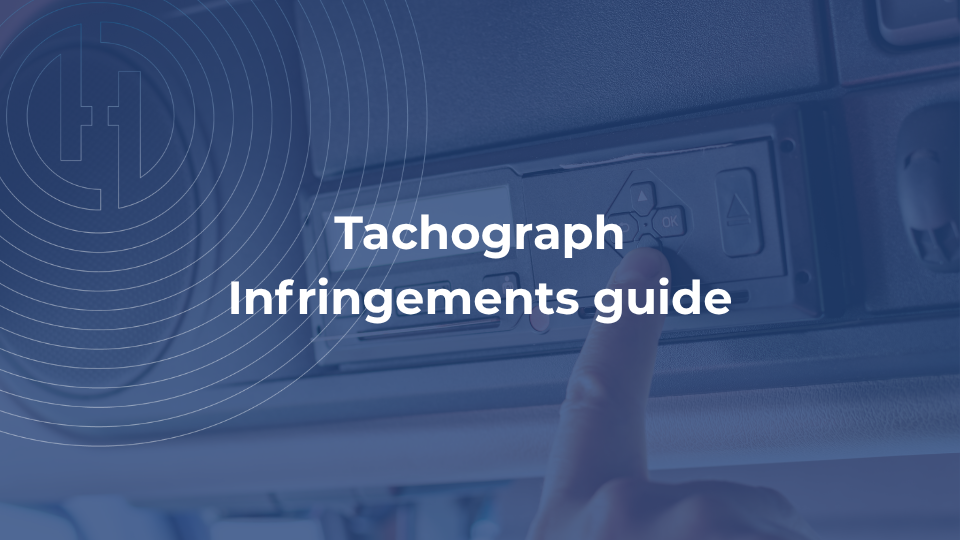
We've pulled all of this together, the most common infringements, what triggers them, and exactly how to prevent each one, into a free downloadable guide.
Click here to download the free Tachograph Infringements Guide
Whether you're reviewing your process for the first time or just want a second pair of eyes on where the gaps might be, it's a five-minute read that could save you a much longer conversation with DVSA.