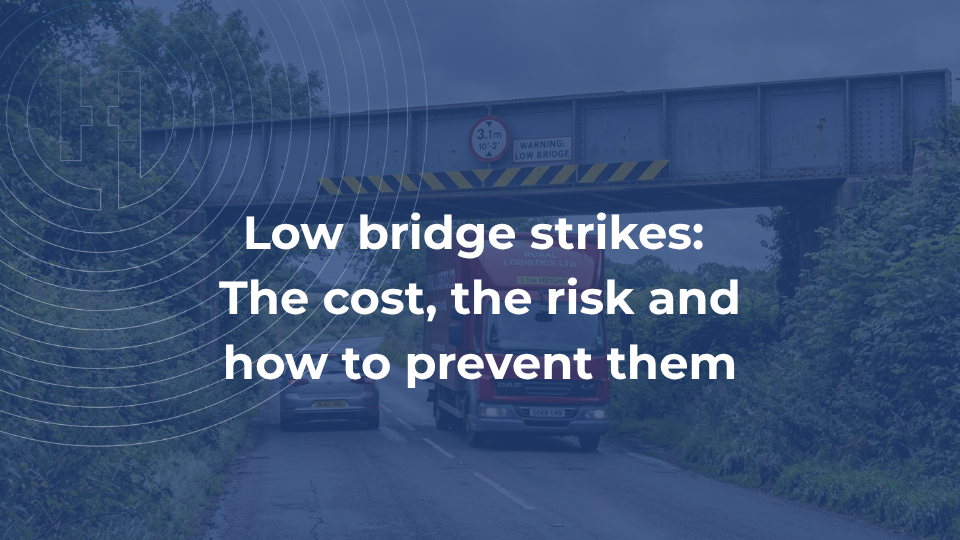
Roughly every five hours, a vehicle hits a railway bridge somewhere in Britain. Network Rail recorded 1,666 bridge strikes between April 2024 and March 2025, and most of the vehicles involved were HGVs and buses.
And we're heading into the worst time of year for them. Network Rail has previously reported that October and November are the peak months for bridge strikes, as delivery volumes climb ahead of Christmas.
What a bridge strike really costs
Network Rail puts the average cost of a single bridge strike at around £13,000, adding up to roughly £23 million a year for the UK taxpayer. Serious incidents cost far more: one A12 bridge in Colchester needed around £2.5 million of repairs after a strike.
For an operator, the bridge repair bill is only the beginning. Network Rail can pursue the operator responsible to recover its costs. On top of that come:
- Damage to the vehicle, trailer and load
- Vehicles off the road and missed deliveries
- Insurance claims and rising premiums
- Risk of injury to the driver, other road users and rail passengers
- Reputational damage when the photos end up online
Why they keep happening
Almost every bridge strike is preventable, and most come down to the same few causes.
Drivers don't know their height. Network Rail research found that 43% of lorry drivers admitted they didn't know the size of their vehicle when setting off.
Heights change. A driver who swaps trailers, changes body type or carries a taller load may be running at a different height to yesterday.
Unfamiliar routes. Diversions, new drops and car sat navs that don't account for vehicle height all lead drivers towards bridges they weren't expecting.
Time pressure. A tight schedule makes "I think we'll fit" more tempting.
The compliance angle
Operators are expected to manage bridge-strike risk as part of running a safe, compliant fleet. Traffic Commissioners take strikes seriously, and a pattern of incidents can raise questions about an operator's systems and, ultimately, their O-licence. Recording vehicle heights, briefing drivers and planning routes are the basics.
How low bridge detection helps
H-TEC's Low Bridge Detection System gives drivers an automatic, early warning before a height conflict becomes a strike.
- Configured to the vehicle. The vehicle's height is set at installation for consistent accuracy, and can be adjusted from a cab control panel where needed.
- Looks ahead. The system identifies height-clearance conflicts ahead of the vehicle using AI, GPS or both together.
- Clear, staged warnings. An LED display and audible alert move from "low bridge detected" to either "safe to proceed" or "danger, bridge too low", so the driver knows exactly where they stand.
- Handles trailer changes. For variable combinations, an RFID reader on the cab detects a Bluetooth tag on the coupled trailer and applies the right height threshold, with no driver set-up required.
- Learns from near misses. Optional event logging and DVR event bookmarks capture height-related incidents, so you can spot problem routes, locations and behaviours.
- Fits your existing set-up. It works standalone or as part of a connected H-TEC safety solution, and fully integrates with the Geotab telematics platform. Installation is plug and play on 12–24V commercial vehicles.
Evidence when you need it
Beyond preventing incidents, the system gives you evidence of proactive fleet-safety measures for audits and insurers, supports internal safety targets, and helps embed a culture of driver awareness and route planning.
Five quick wins for this autumn
- Measure and record the height of every vehicle and trailer combination.
- Make sure the current height is clearly displayed in the cab.
- Use route planning built for HGVs, not car sat navs.
- Cover bridge strikes in your next toolbox talk.
- Treat near misses as seriously as strikes, and log them.